Platform categories

Adult platform types create different control problems.

Platform Independence Index / 9-category hub / June 2026

Platform Categories is the hub for the nine adult platform models tracked by Adult Platform Audit. Each model affects worker control differently. The question is not whether a tool is popular. The question is who controls clients, money, pricing, communication, visibility, rules, discipline, portability, work method, traffic, and exit power.

Simple category map

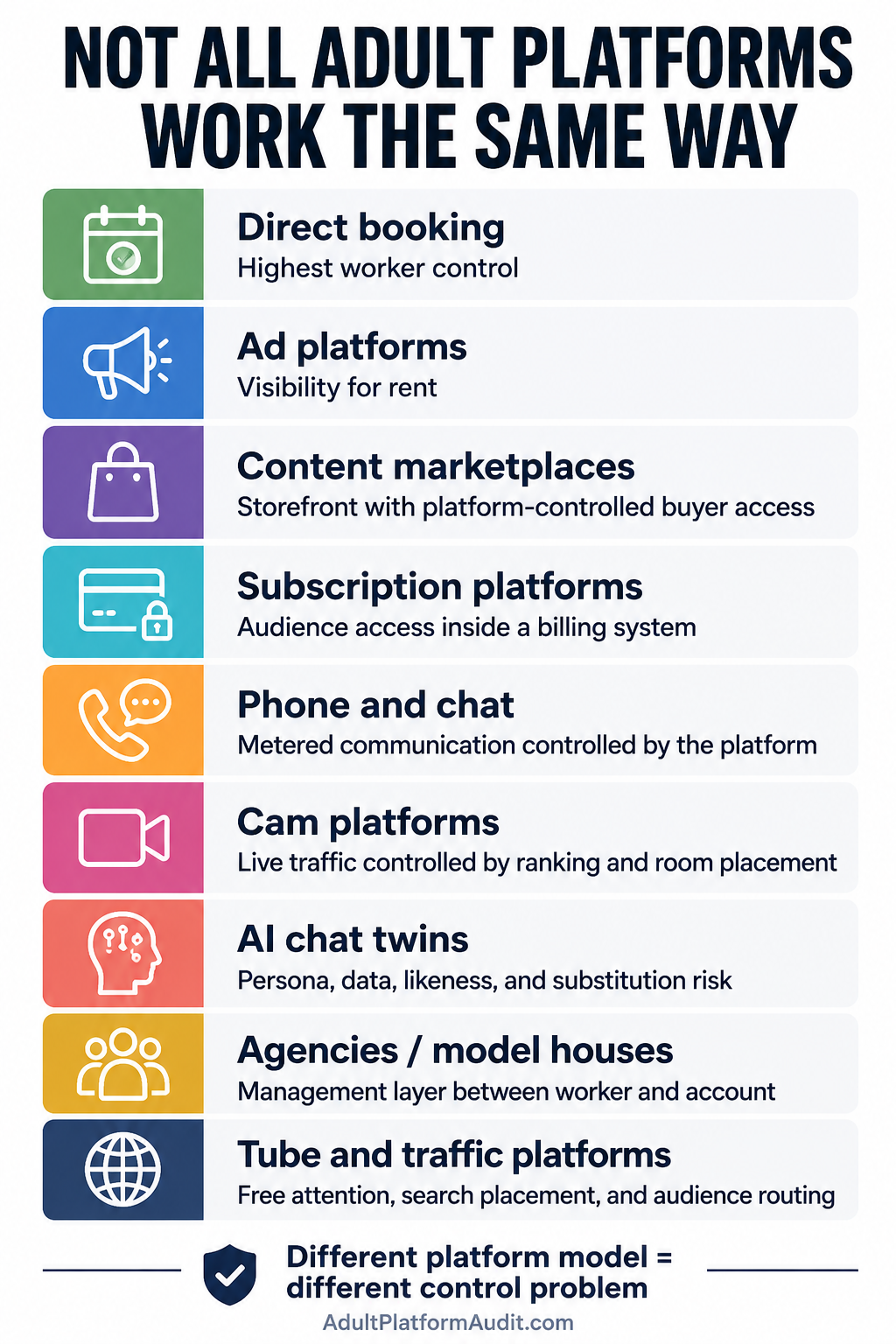
Not all adult platforms work the same way.

A directory, cam site, subscription platform, AI twin tool, agency, tube site, and direct booking system do not create the same control problem.

This image gives workers the basic category map before they compare scores or read individual platform pages.

Different platform model = different control problem.

Infographic explaining that direct booking, ad platforms, content marketplaces, subscription platforms, phone and chat, cam platforms, AI chat twins, agencies or model houses, and tube and traffic platforms work differently.

Category map

Nine platform types. Nine different structures.

These categories are not moral rankings, legal conclusions, or recommendations. They are structural categories for identifying where worker control usually sits before reviewing a specific company.

Category 1

Direct Booking

39 to 47 typical range

Worker controls clients, pricing, communication, screening, payment choices, brand, and exit path.

Read category
Category 2

Ad Platforms

30 to 40 typical range

Useful when they behave like advertising. Risk rises when visibility, reviews, verification, or profile rules become gatekeeping systems.

Read category
Category 3

Content Marketplaces

22 to 36 typical range

Worker may control content and prices, while the platform controls storefront, payout, buyer access, refund rules, search, and catalog visibility.

Read category
Category 4

Subscription Platforms

22 to 36 typical range

Recurring audience tools can help, but account access, subscriber relationships, billing, messages, and content libraries may be platform-held.

Read category
Category 5

Phone and Chat

16 to 32 typical range

Worker may control style and schedule, while the platform controls calls, billing, routing, ranking, recording rules, and repeat access.

Read category
Category 6

Cam Platforms

12 to 25 typical range

Traffic and tools may come with platform control over ranking, rules, payment flow, compliance, communication, and client portability.

Read category
Category 7

AI Chat Twins

8 to 35 typical range

Risk depends on likeness, voice, persona, automation, training data, deletion rights, revenue split, client access, and post-exit use.

Read category
Category 8

Agencies and Model Houses

6 to 29 typical range

Highest risk when a management layer controls accounts, clients, messages, content, money, branding, schedule, and exit.

Read category
Category 9

Tube and Traffic Platforms

14 to 26 typical range

Tube sites can create visibility, but the platform may control search placement, recommendations, monetization, takedowns, viewer data, and traffic conversion.

Read category

How to use this page

Start with the model before judging the company.

A company audit should not begin with whether a platform is popular, familiar, profitable, or disliked. It should begin with the structure. The category tells the worker what kind of control problem is likely to appear.

A platform may offer traffic, billing, messaging, automation, hosting, discovery, search placement, or account management. The independence question is what the worker gives up to use those tools.

Important limit

Category ranges are not final audits.

These ranges are category-level estimates. A specific company may score higher or lower depending on its actual terms, payout systems, visibility rules, communication limits, enforcement practices, data rights, search behavior, takedown process, and worker controls.

The Platform Independence Index measures control. It does not measure legality, personal safety, profitability, morality, tax exposure, or whether a platform is suitable for a specific worker.

Fast comparison

Where control usually sits.

This table gives a quick worker-side reading of the platform categories. Each category name links to its separate category page.

Category Usually strongest Main dependency risk What to inspect first
Direct Booking Client ownership, pricing control, communication freedom, brand portability, and exit power. Worker must manage screening, marketing, payment choice, records, boundaries, and safety planning directly. Payment routing, screening process, client records, booking terms, and independent traffic sources.
Ad Platforms Direct client inquiry and independent payment can remain worker-controlled. Visibility may become dependent on paid placement, verification, review display, profile rules, or search ranking. Listing control, paid ranking, review policy, verification requirements, and contact restrictions.
Content Marketplaces Content production, catalog strategy, and sometimes pricing. Platform may control storefront search, payout timing, processing, refunds, buyer access, and buyer relationship. Payment terms, refund rules, buyer contact, search placement, takedown rules, and content export.
Subscription Platforms Recurring content schedule, fan-facing brand, and paid message strategy. Subscriber list, billing, message history, account access, and content library may be platform-held. Subscriber export, payout rules, account termination terms, content rules, and off-platform link limits.
Phone and Chat Conversation style and scheduling flexibility. Platform may control caller access, billing, per-minute rate structure, ranking, recording, and contact routing. Caller portability, ranking system, payout terms, call recording policy, and off-platform contact rules.
Cam Platforms Live performance style and schedule may remain partly worker-controlled. Traffic, ranking, viewer relationship, tokens, tips, payment flow, compliance, and discipline may be platform-controlled. Token economics, placement, communication rules, discipline process, client portability, and payout deductions.
AI Chat Twins May create scale if the worker controls persona, consent, limits, data, and usage boundaries. Worker likeness, voice, persona, data, client access, and future revenue may become platform-controlled. Likeness rights, training data rights, deletion rights, revenue split, substitution limits, and post-exit use.
Agencies and Model Houses May provide management, tech help, scheduling, marketing, or account labor. Agency may control accounts, clients, messages, content, money, brand, schedule, and exit conditions. Account ownership, payout records, client access, content rights, login control, and termination terms.
Tube and Traffic Platforms Traffic, search visibility, archive discovery, and possible funnel exposure. Platform may control search placement, recommendations, ad revenue, upload rules, takedowns, data, and audience movement. Verified ownership, upload control, takedown process, search placement, external links, analytics, and monetization terms.

Reading guide

The issue is control transfer.

Every platform model offers something. The worker-side question is what control transfers away from the worker in exchange for that tool.

Highest control

Direct booking is the baseline.

Direct booking usually gives the worker the most control over clients, money, pricing, communication, boundaries, brand, and exit power. The tradeoff is that the worker must manage more of the business directly.

Middle control

Ad and audience tools can help.

Ad platforms, content marketplaces, subscription platforms, and some traffic systems can be useful when they expand visibility or monetization without trapping the worker's audience, payment flow, account access, content, or reputation.

Higher dependency

Hosted systems can capture the business.

Phone, chat, cam, AI, agency, model-house, and traffic systems become riskier when they control client access, ranking, identity, communication, payment records, content, likeness, data, discipline, or exit terms.

Inspection questions

Before scoring a company, ask who controls the asset.

A category gives the likely pattern. A platform audit needs evidence. These questions help identify where control actually sits.

Client and money control

  • Clients: Can the worker identify, retain, contact, and move repeat clients?
  • Payments: Who controls billing, processing, payout timing, refunds, chargebacks, and records?
  • Pricing: Can the worker set rates, discounts, bundles, tips, minimums, and custom terms?
  • Portability: Can the worker leave without losing the audience, records, content, traffic, or brand identity?

Visibility and discipline control

  • Visibility: Who controls search, ranking, placement, recommendations, boosts, and suppression?
  • Communication: Can the worker move conversations, share links, screen clients, and set boundaries?
  • Rules: Are rules clear, stable, appealable, and evenly enforced?
  • Discipline: Can the platform suspend, demote, shadow-restrict, demonetize, withhold funds, or terminate access?

Bottom line

Category tells the worker what kind of control problem to expect.

Direct booking usually gives the most control but requires the most self-management. Ad platforms can be worker-favorable when they remain advertising tools. Hosted marketplaces, subscription systems, phone and chat systems, cam platforms, tube systems, and traffic platforms may provide infrastructure while capturing audience, money, visibility, data, and records. AI chat twins add likeness and substitution risk. Agencies and model houses add a management layer that can reduce independence quickly.