Platform Independence Index / Category Guide

Subscription platforms.

Subscription platforms let adult workers charge recurring fees for access to content, messages, custom work, fan interaction, private feeds, or exclusive updates. They can be useful business tools, but usefulness is not the same thing as independence.

Core principle: Subscribers are not always portable clients. A worker may build recurring revenue on a platform while the platform still controls payment processing, account access, subscriber contact, discovery, content rules, and enforcement.

Subscriptions Subscriber access Paid messages Platform payouts Recurring revenue

Recognizable examples in this category

These examples are included to help readers understand the platform model. Inclusion does not mean endorsement, accusation, ranking, or full audit.

  • OnlyFans
  • Fansly
  • JustForFans
  • LoyalFans
  • FanCentro
  • Fanvue

Subscription platform Independence Index estimates

These desktop review estimates compare recognizable subscription platforms through the same worker-side lens used across Adult Platform Audit: client control, money, pricing, communication, visibility, rules, discipline risk, portability, and work method.

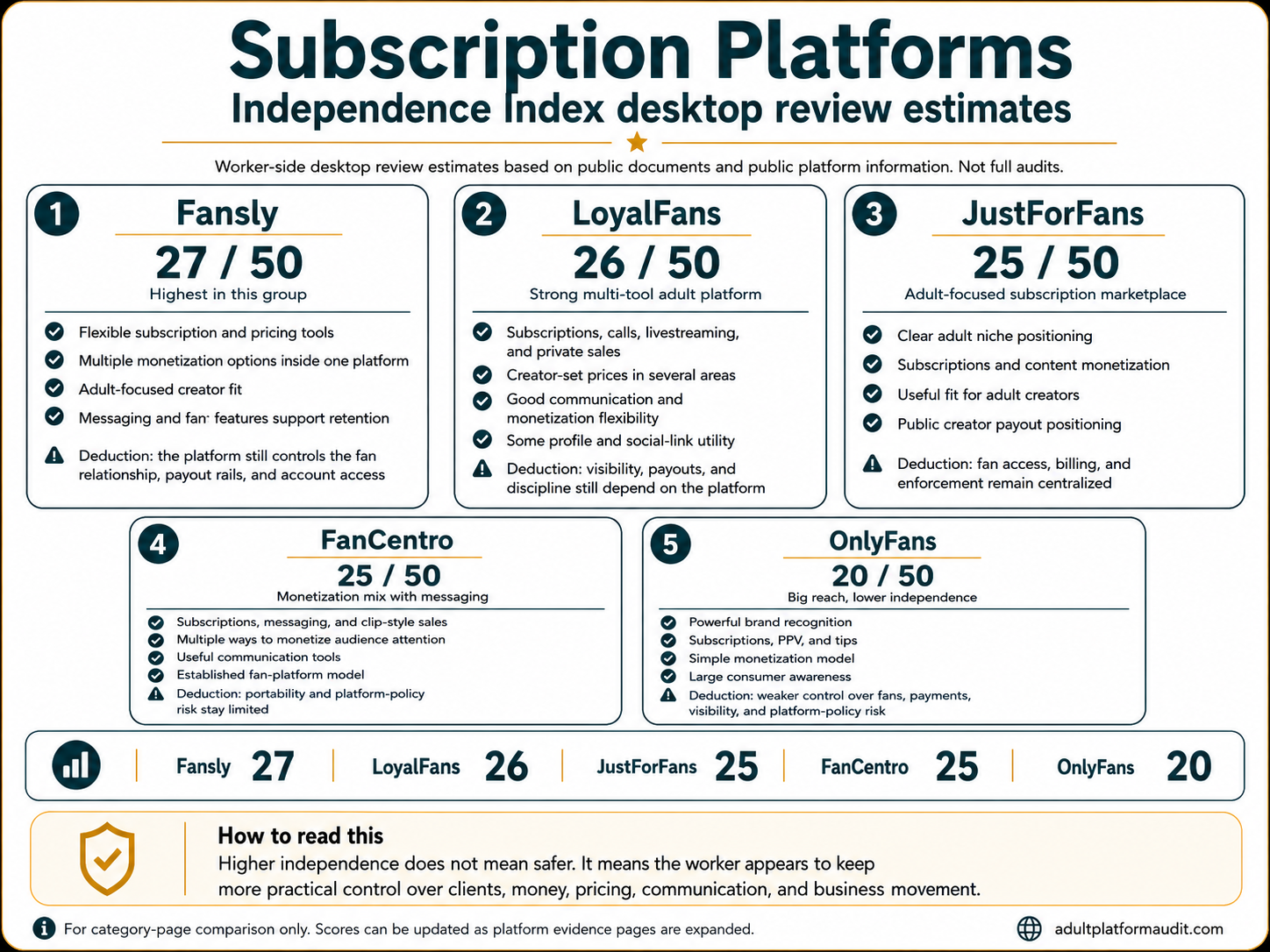
Subscription Platforms Independence Index desktop review estimates comparing Fansly, LoyalFans, JustForFans, FanCentro, and OnlyFans.
Overall Independence Index estimates for five subscription platforms. Higher independence means more practical worker control, not more traffic or popularity.
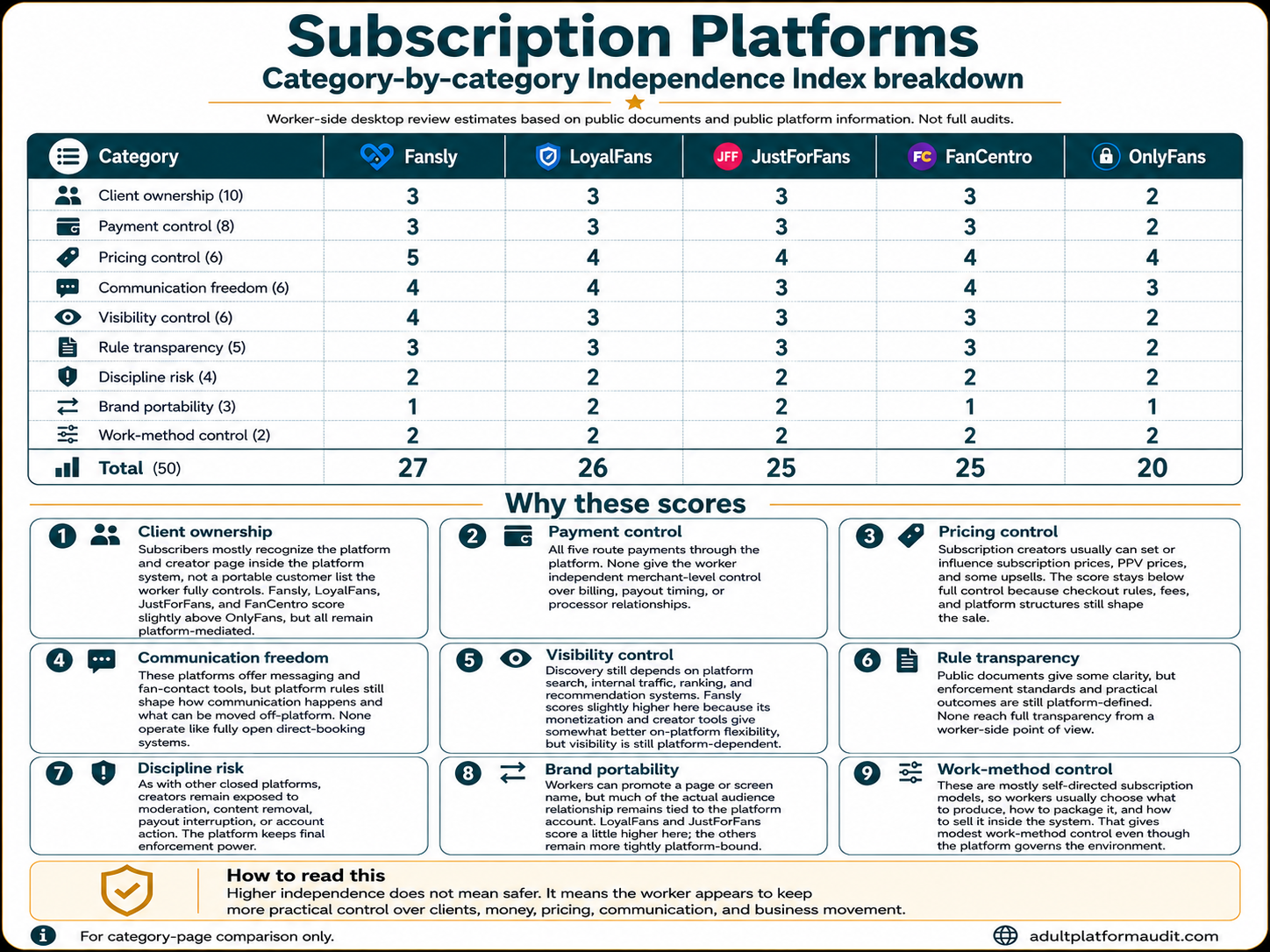
Subscription Platforms category-by-category Independence Index breakdown showing client ownership, payment control, pricing control, communication freedom, visibility control, rule transparency, discipline risk, brand portability, work-method control, and total scores.
Category-by-category breakdown showing why the subscription platform estimates differ.
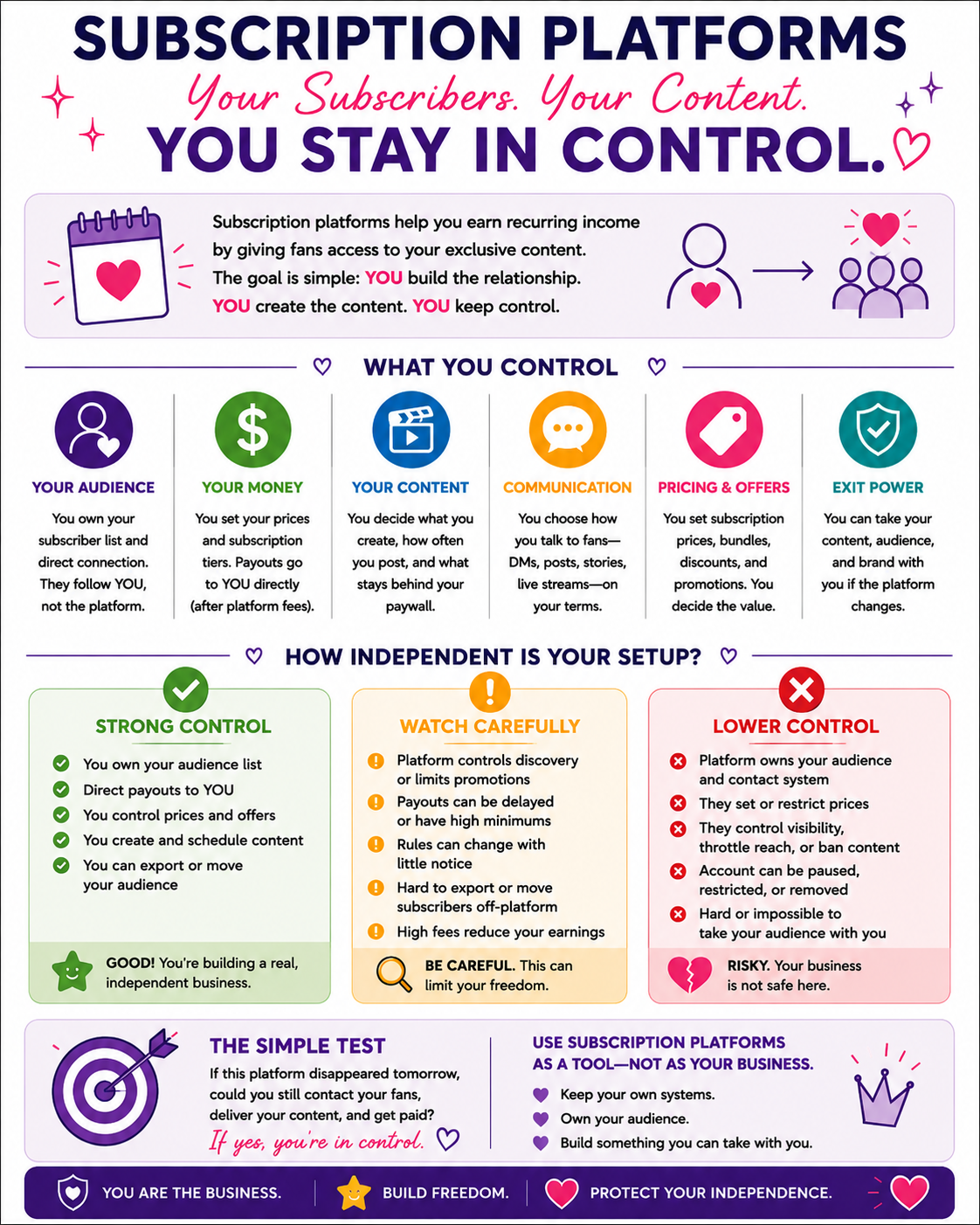
Subscription Platform Control Check infographic explaining how models can earn recurring income while keeping control of audience, money, content, communication, pricing, and exit power.
Quick control check for evaluating any subscription platform before building too much of the business inside it.

Current status: The graphics on this page are desktop review estimates based on public documents and public platform information. They are not full audits, legal conclusions, safety ratings, or endorsements. Scores can be updated as evidence pages, platform testing, and current policy documentation are expanded.

What this page measures

This page evaluates subscription platforms using the 50-point Platform Independence Index. The score measures worker control across client ownership, payments, pricing, communication, visibility, rules, discipline, brand portability, and work-method control.

The score does not measure morality, legality, income potential, popularity, buyer quality, traffic volume, or whether a platform is good or bad. A platform can be valuable and still structurally controlling.

Desktop review estimates

Top subscription platform estimates.

These estimates are included for category-page comparison only. They show how much practical control a worker appears to keep inside each platform structure, not which platform is safest, biggest, most profitable, or best for every worker.

Estimated totals

Fansly27 / 50
LoyalFans26 / 50
JustForFans25 / 50
FanCentro25 / 50
OnlyFans20 / 50
Scoring factors

Subscription platform independence factors.

The central question is whether the platform helps the worker sell access to a portable audience, or whether it controls the subscriber relationship, payment system, content access, visibility, and continuity of the business.

Variable Max points What to examine
Client ownership 10 Can the worker identify, retain, and recontact subscribers outside the platform, or does the platform keep the subscriber relationship locked inside its account, username, message, and billing system?
Payment control 8 Does the worker choose the payment processor and receive direct payment, or does the platform control payment processing, payout timing, reserves, deductions, chargebacks, refunds, holds, and access to earnings?
Pricing control 6 Can the worker set subscription prices, discounts, trials, custom rates, tips, bundles, paid-message prices, pay-per-view prices, and custom content rates, or are prices limited by platform rules and preset structures?
Communication freedom 6 Can the worker communicate directly with subscribers and move the relationship off-platform, or must communication remain inside platform messaging, comment, live, and notification tools?
Visibility control 6 Does the worker control visibility through an independent funnel, or does the platform control search placement, recommendations, rankings, boosts, categories, featured placement, and account discoverability?
Rule transparency 5 Are content rules, payment rules, promotion rules, messaging rules, payout rules, and enforcement standards public, clear, stable, and understandable before enforcement?
Discipline risk 4 If the platform suspends, restricts, removes, shadow-limits, demonetizes, or terminates an account, can the worker continue operating with minimal business interruption?
Brand portability 3 Does the worker keep control of their name, images, content identity, social links, website, subscriber funnel, reputation, and outside audience?
Work-method control 2 Does the worker control when, where, how, and under what conditions the work happens, or does the platform impose meaningful operating conditions?

Common independence strengths

  • Workers often control their posting schedule and general content plan.
  • Subscription prices may be adjustable within platform limits.
  • Workers may keep their public-facing name, photos, profile style, and promotional identity.
  • Some platforms allow tipping, paid messages, pay-per-view posts, custom content, bundles, trials, or discounts.
  • Recurring access can help stabilize income when the worker also maintains an outside funnel.
  • Subscription pages can give workers a simple place to send traffic from social media, advertising, or private promotion.

Common independence limits

  • The platform usually controls payment processing, payout access, deductions, and account balances.
  • Subscribers often remain inside the platform account and messaging system.
  • Off-platform contact may be restricted, discouraged, monitored, or treated as rule-sensitive.
  • Visibility may depend on search, recommendations, rankings, boosts, tags, categories, or algorithmic placement.
  • Account discipline can affect access to audience, income, content, messages, and subscriber records.
  • A worker can build recurring revenue without owning the durable client list behind that revenue.
Score bands

Recurring access can still be platform-dependent.

Subscription platforms can fall anywhere on the Index depending on their structure. A higher score means the worker keeps more control. A lower score means the business depends more heavily on the platform.

45 to 50Highly independent
35 to 44Mostly independent, platform still useful
25 to 34Mixed control and independence
15 to 24Platform-dependent
0 to 14Highly controlled or low independence

Key tradeoff

Subscription platforms may provide payment tools, hosting, messaging, profile pages, and subscriber management in one place. In exchange, the worker often gives up some control over payment access, account rules, subscriber portability, content access, and visibility.

The central question is not whether the platform is useful. The central question is whether the worker can keep operating if the platform changes rules, limits reach, delays payouts, removes content, or closes the account.

Information needed for a full platform score

  • Current platform terms of service.
  • Worker payout terms and platform fee structure.
  • Content, promotion, and messaging rules.
  • Off-platform contact rules.
  • Subscriber access and data portability rules.
  • Search, recommendation, boost, ranking, and visibility policies.
  • Account suspension, content removal, fund hold, and appeal policy.
  • Evidence from live worker testing, if available.
Public comparison

Estimated category scores.

This table mirrors the category-by-category infographic above for readers who want the numbers in text form.

Category Fansly LoyalFans JustForFans FanCentro OnlyFans
Client ownership /1033332
Payment control /833332
Pricing control /654444
Communication freedom /644343
Visibility control /643332
Rule transparency /533332
Discipline risk /422222
Brand portability /312211
Work-method control /222222
Total /502726252520

Bottom line.

Subscription platforms can help workers package and sell recurring access, but they often place important parts of the business inside the platform’s control. That can include payment access, subscriber contact, content access, messaging, visibility, and account enforcement.

A stronger independence position exists when the worker keeps a portable brand, an independent client funnel, clear payment expectations, subscriber contact outside the platform, and a way to continue operating beyond the platform.

Compare categories

Note: Adult Platform Audit is informational. It does not provide legal, financial, tax, safety, technical, privacy, intellectual-property, data-security, or employment advice. Category guides are structural analysis, not platform endorsements or legal conclusions. Platform rules, payout systems, moderation practices, content rules, subscriber systems, billing systems, and visibility systems can change.