Control location
The core question is who controls the business asset: the worker, the platform, the payment system, the algorithm, the traffic system, the account owner, or the management layer.
Category comparison
This page compares adult platform models across the control areas that matter most to worker independence: client relationship, money and pricing, visibility and rules, portability, traffic control, and exit power. Use Platform Categories to understand what each model is. Use this page to see how the models differ.
Simple category map
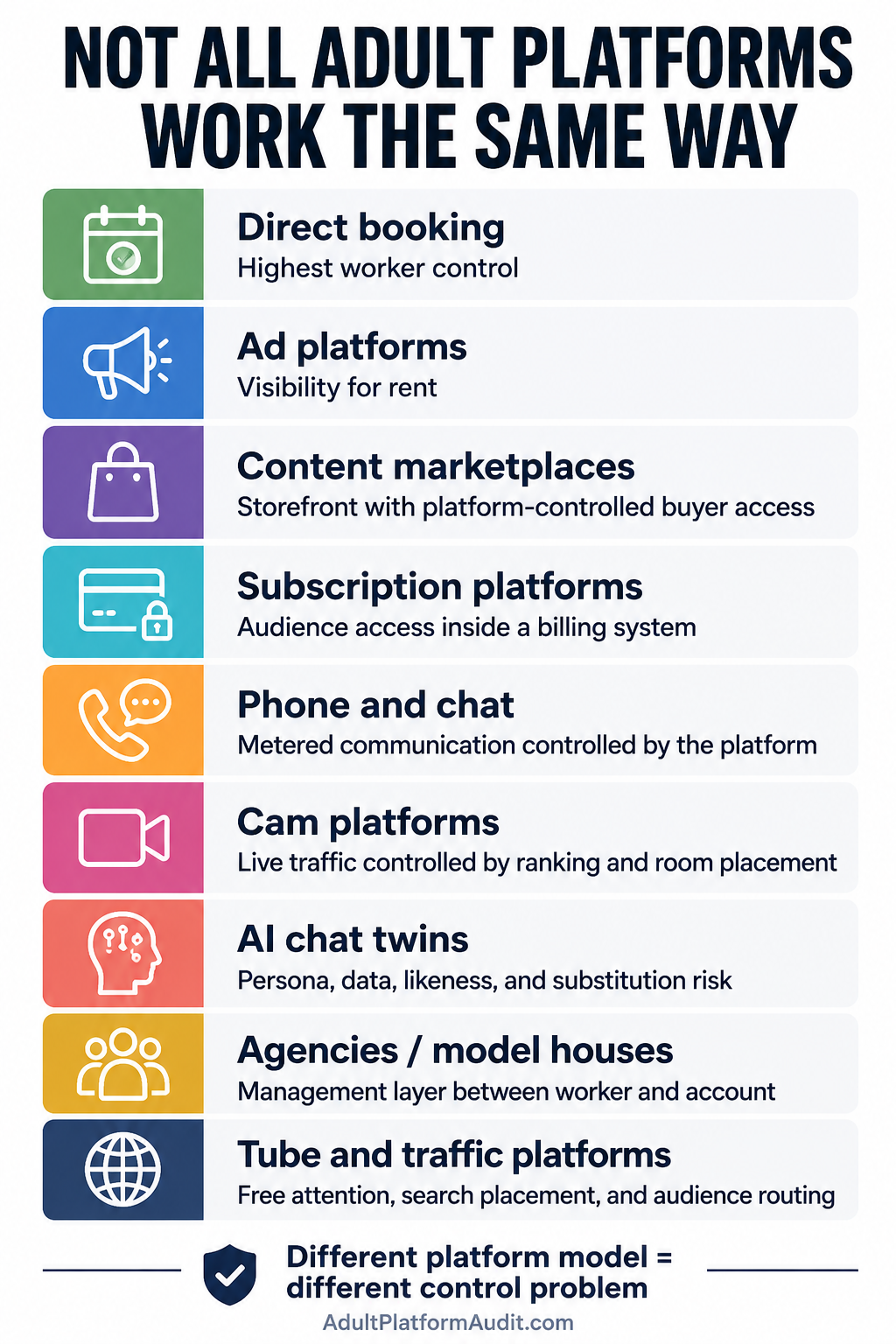
A cam platform, agency, subscription site, directory, phone and chat system, AI twin tool, tube site, and direct booking structure do not create the same control problem.
This image gives workers the category map before the side-by-side comparison matrix.
Different platform model = different control problem.
Page role
The category hub explains the nine platform models. This page compares them side by side. It shows where worker control usually stays with the worker and where it tends to move into a platform, payment system, ranking system, account system, traffic system, automation layer, or management layer.
The core question is who controls the business asset: the worker, the platform, the payment system, the algorithm, the traffic system, the account owner, or the management layer.
A category is not a final audit. Two companies in the same category can score differently depending on terms, interface rules, payout systems, search placement, and enforcement practices.
A final score needs documents, screenshots, payout records, policies, account controls, worker tools, search behavior, discipline practices, and appeal procedures.
Comparison matrix
Each row compares a category across the same worker-control dimensions. The point is not whether a platform type is good or bad. The point is what the worker keeps, what the worker rents, and what the worker may lose access to if the relationship ends.
| Category | Client relationship | Money and pricing | Visibility and rules | Portability and exit power |
|---|---|---|---|---|
| Direct Booking 39 to 47 | Worker usually controls screening, repeat access, direct contact, boundaries, follow-up, and client records. | Worker usually sets rates, deposits, payment methods, minimums, cancellation terms, custom terms, and records. | Visibility is built through independent traffic, referrals, social media, search, reputation, and direct links. | Strongest portability because clients, brand, records, payment tools, and communication can exist outside one service. |
| Ad Platforms 30 to 40 | Worker may control the client after inquiry, but discovery depends on the ad system. | Worker often controls payment directly unless the platform adds booking, deposit, escrow, or processing tools. | Platform may control paid placement, verification, review display, profile rules, search, and listing access. | Moderate to high portability when the worker keeps direct contact, brand identity, independent payment flow, and off-platform records. |
| Content Marketplaces 22 to 36 | Buyer relationship may be partly platform-mediated through storefronts, messages, favorites, reviews, and internal accounts. | Worker may set prices, but the platform usually controls fees, refunds, processing, payout timing, and catalog rules. | Platform may control search, category placement, upload rules, takedowns, account visibility, and content standards. | Portability depends on whether the worker can move audience, catalog value, reputation, content, and buyer contact elsewhere. |
| Subscription Platforms 22 to 36 | Subscribers may feel worker-facing, but account access, messages, billing, and subscriber lists may remain platform-held. | Worker may set subscription or message prices while the platform controls billing, chargebacks, fees, and payout timing. | Platform controls content rules, account moderation, discovery tools, recommendation systems, and link limits. | Exit risk rises when the worker cannot export subscriber relationships, message history, content libraries, or payment continuity. |
| Phone and Chat 16 to 32 | Client contact is often routed through platform numbers, internal chat, metered tools, or account identities. | Platform often controls per-minute billing, caller payment systems, payout timing, fees, and account balances. | Platform may control ranking, online status, categories, profile rules, call routing, recording, and messaging limits. | Portability is limited when repeat callers, numbers, chats, reviews, and account identity stay inside the system. |
| Cam Platforms 12 to 25 | Platform often controls viewer access, internal identity, favorites, messaging, and repeat contact. | Platform controls tokens or credits, payout structure, tips, fees, refunds, chargebacks, and promotional systems. | Platform may control ranking, homepage exposure, contests, rules, compliance monitoring, and account discipline. | Exit risk can be high because removal can cut off viewers, income flow, internal reputation, and payment access at once. |
| AI Chat Twins 8 to 35 | Client relationship may shift from worker to automated persona, platform interface, or managed fan interaction. | Revenue share, pricing, billing, model access, and monetization terms may be platform-controlled. | Platform may control persona behavior, prompt limits, moderation, likeness use, training data, and deployment rules. | Exit risk depends on whether the worker can remove likeness, data, persona history, client access, and future use rights. |
| Agencies and Model Houses 6 to 24 | Agency or studio may control accounts, client flow, chats, bookings, scheduling, and repeat customer access. | Agency may control revenue routing, platform accounts, payout timing, fee splits, chargebacks, and financial records. | Agency may control presentation, content strategy, posting, ranking strategy, discipline, and work conditions. | Exit risk is highest when the worker cannot take accounts, clients, brand, records, content, or income systems when leaving. |
| Tube and Traffic Platforms 14 to 26 | Viewer attention may be large, but the platform usually controls search paths, repeat access, viewer data, recommendations, and the route back to the worker. | Worker income may depend on ads, traffic volume, eligibility, revenue share, external funnel conversion, or platform-controlled monetization. | Platform may control search ranking, tags, categories, recommendations, suppression, takedowns, account trust, and upload rules. | Exit risk rises when the worker cannot remove content, redirect viewers, export data, protect brand value, or convert attention into worker-owned income. |
Control gradient
A platform can be useful and still create dependency. The key distinction is whether the worker keeps the business assets or only gets temporary access through someone else's system.
The worker can keep clients, choose payment tools, set prices, communicate directly, preserve brand identity, and leave one tool without losing the business.
The platform may create traffic, storefront tools, billing, visibility, or communication systems while also controlling records, payouts, buyer access, placement, or account stability.
The platform, traffic system, automation layer, agency, or model house controls clients, money, rules, placement, content access, identity, discipline, or exit conditions.
Client capture
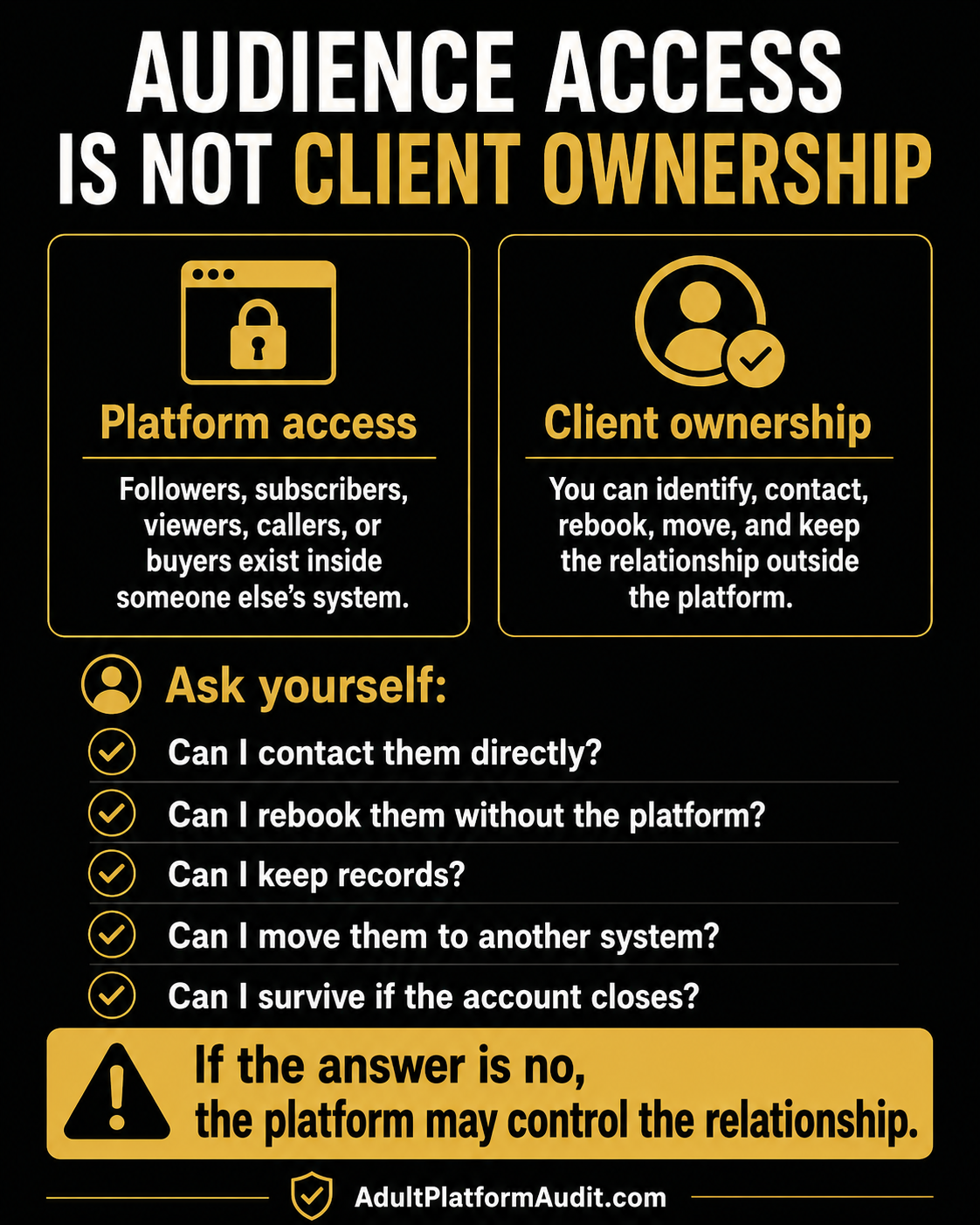
A worker may have followers, subscribers, viewers, callers, or buyers inside a platform and still not control the relationship.
Client ownership means the worker can identify, contact, screen, rebook, move, and retain the relationship outside the platform.
If the account closes and the relationship disappears, the platform may control the client asset.
Warning signs
These signals matter across categories. They are not final proof of low independence, but they show where a platform audit should look first.
Best use
Category comparison helps separate the platform model from the company brand. Two companies in the same category can score differently, but the category tells the worker what control questions are most likely to matter.
Is the worker using direct booking, advertising, a storefront, a subscription tool, phone or chat, cam infrastructure, AI automation, a management layer, or a tube and traffic system?
Identify what moves away from the worker: clients, money, prices, messages, visibility, search placement, rules, account access, content, data, traffic, or brand identity.
A final audit needs documents, terms, screenshots, payout records, interface rules, moderation practices, worker controls, search behavior, takedowns, and appeal procedures.
Read next
The matrix shows the tradeoffs. The category pages explain the model in more detail.
Important limit
These ranges are category-level estimates. They are not final scores for any named company. A high-independence structure can still carry safety, payment, legal, privacy, intellectual-property, technical, or client risks. A lower-independence structure may still be useful for some workers as one part of a broader income strategy. The Index measures worker control, not moral worth, profitability, legality, or personal fit.