Core structural issue
Tube platforms can make a worker searchable without making the audience portable. The platform often controls placement, monetization, data, takedowns, account rules, and the route from viewer attention to worker income.
Tube and traffic platforms sell visibility. They distribute adult video through search, recommendations, embeds, free viewing, previews, ads, and large traffic systems. They can create reach, but reach is not the same as worker control.
Core principle: Visibility is not independence. A platform may make a worker searchable while still controlling placement, monetization, data, takedowns, account rules, and the route from viewer attention to worker income.
These examples are included to help readers understand the platform model. Inclusion does not mean endorsement, accusation, ranking, or full audit.
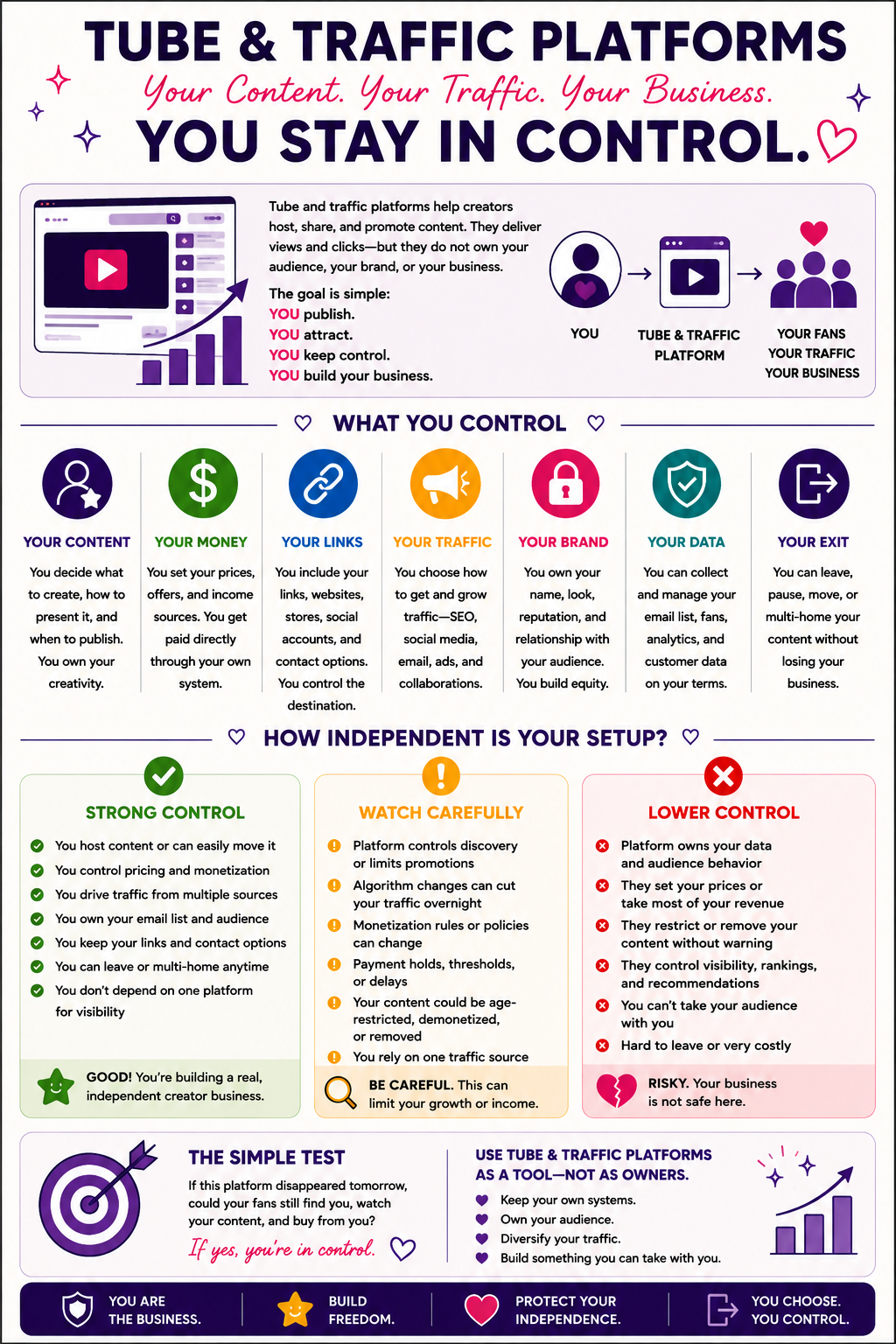
Quick model-side checklist: traffic only helps when it can become something you control.
Tube platforms can make a worker searchable without making the audience portable. The platform often controls placement, monetization, data, takedowns, account rules, and the route from viewer attention to worker income.
Current status: This is a category-level structural guide, not a final audit of any specific company. Named platform reviews should be published separately as preliminary desktop reviews or full audits only when the evidence level is clear.
This category covers adult video portals, tube sites, free clip sites, traffic networks, ad-supported adult video platforms, embed systems, and search-based discovery platforms where visibility is the main product.
Large adult video portals built around uploads, free viewing, search, tags, recommendations, and archive traffic.
Systems that gather viewer attention and route it toward videos, profiles, ads, external links, paid platforms, or other funnels.
Sites where the platform captures value through ads, placement, volume, previews, embeds, or internal monetization rules.
Worker-side question: The issue is not whether the site has traffic. The issue is whether the worker can control, convert, protect, and move the value created by that traffic.
Tube and traffic platforms are not direct booking systems, ad directories, content stores, subscription pages, or cam platforms. Their central product is attention.
| Compared with | Structural difference |
|---|---|
| Direct booking platforms | Direct booking platforms are built around client contact. Tube platforms are built around attention. A viewer may watch the worker without becoming the worker’s client. |
| Advertising platforms | Ad platforms usually sell listing placement so clients can contact workers. Tube platforms usually keep viewers inside a traffic and content system. |
| Content marketplaces | Content marketplaces center paid purchases. Tube platforms often center free viewing, previews, ads, embeds, and indirect conversion. |
| Subscription platforms | Subscription platforms center recurring paid access to a creator. Tube platforms may create discovery without giving the worker a durable subscriber relationship. |
| Cam platforms | Cam platforms center live interaction. Tube platforms center uploaded video, search traffic, recommendations, and passive viewing. |
Tube traffic can be useful, but only when visibility can be converted into worker-controlled income, audience, identity, or leverage.
Tube and traffic platforms usually score low to moderate because they can offer reach while limiting control over clients, money, pricing, communication, visibility, discipline, data, takedowns, and exit power.
Usually weak. The viewer may know the worker’s name, but the platform usually controls repeat access and the route back to that viewer.
Often limited. Income may depend on ad rules, traffic volume, eligibility, revenue share, payout rules, or off-platform conversion.
Usually weak when free viewing is the core model. It improves when the worker can sell premium access, clips, subscriptions, bookings, or direct services.
Usually limited. Comments, messages, links, descriptions, and off-platform contact may be restricted, moderated, hidden, or unavailable.
Central but unstable. Search placement, recommendations, tags, categories, account trust, and moderation can determine whether the worker is seen.
Usually weak unless the worker can move viewers to an owned site, mailing list, private booking page, paid platform, or direct communication channel.
Score improvement: The score improves only when the worker can verify ownership, control uploads, link out, monetize clearly, access useful data, and convert traffic into a portable audience.
A tube or traffic audit should measure control, not popularity. High traffic does not automatically mean high worker independence.
The practical difference is whether the platform only captures attention, or whether it gives the worker a realistic path to control that attention.
Note: Adult Platform Audit is informational. It does not provide legal, financial, tax, safety, technical, or employment advice. Category guides are structural analysis, not platform endorsements or legal conclusions. Platform rules, payout systems, moderation practices, ranking systems, upload systems, takedown systems, monetization systems, and visibility systems can change.