Platform Independence Index / Category Guide

Direct booking systems.

Direct booking systems help workers receive inquiries, screen clients, manage availability, take deposits, confirm appointments, send reminders, and organize client communication outside a full marketplace. They can be one of the more independent structures when the worker controls the client relationship, payment flow, brand, and booking rules.

Core principle: Direct access is stronger than platform dependency. A booking system is more independent when it supports the worker’s own client funnel instead of owning the clients, payments, communication, visibility, or account access.

Direct inquiries Scheduling Deposits Screening Client funnel

Recognizable examples in this category

These examples are included to help readers understand the direct-booking model. Inclusion does not mean endorsement, recommendation, compliance approval, ranking, or full audit. Adult-use, payment, privacy, and acceptable-use rules must be checked before relying on any tool.

  • independent personal websites
  • Jotform intake forms
  • Typeform intake forms
  • Acuity Scheduling booking pages
  • Calendly scheduling links
  • direct email or SMS inquiry workflows

Direct Booking Control Check

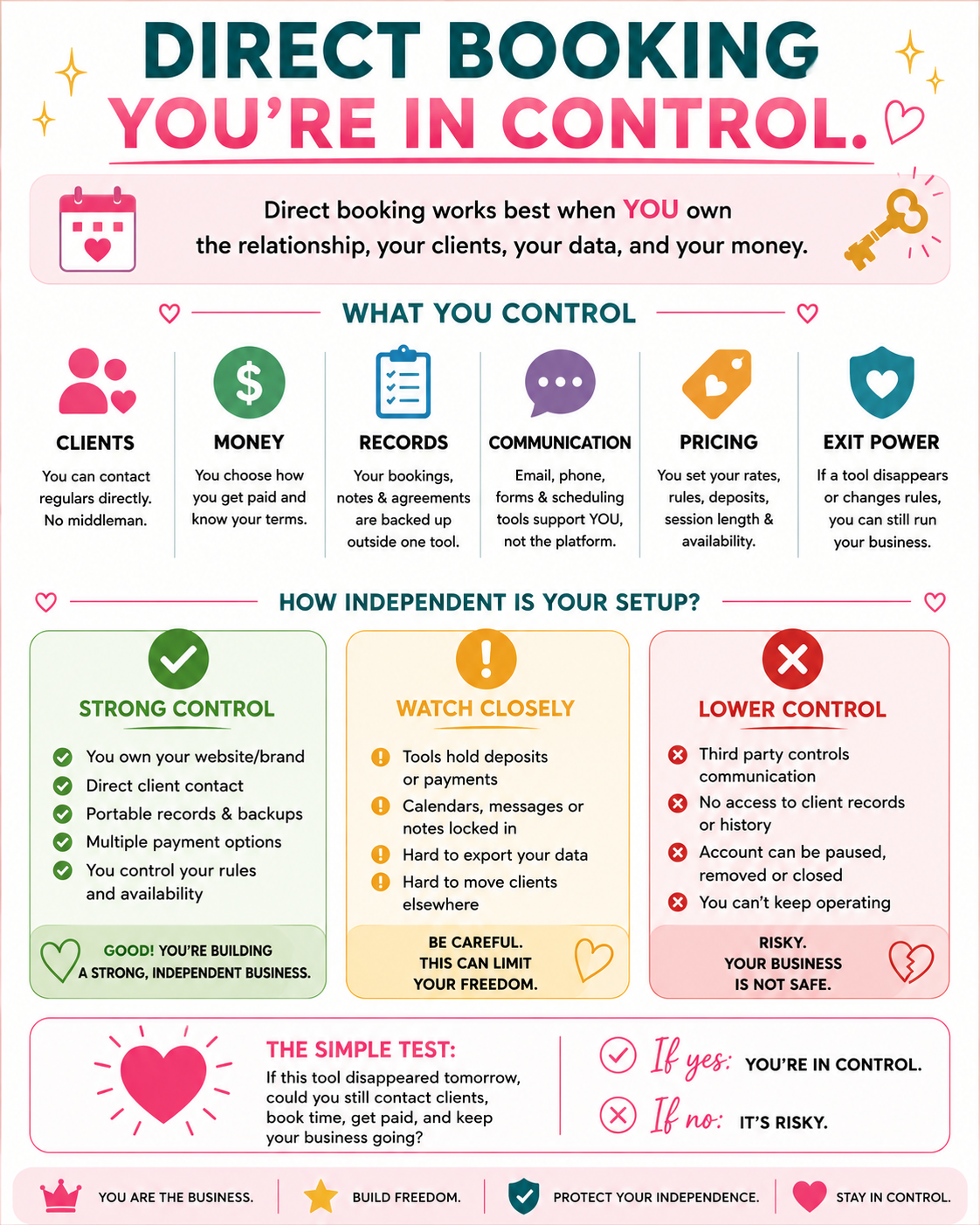
A quick visual guide for models: direct booking is strongest when the worker keeps control of clients, money, records, communication, pricing, and exit power.

Direct Booking Control Check infographic explaining how models can keep control of clients, money, records, communication, pricing, and exit power.

Current status: This is a category-level structural guide, not a scored review of a specific booking system. System-specific scores should be treated as preliminary unless current terms, payment settings, client-data controls, and worker-side testing support the findings.

What this page measures

This page applies the 50-point Platform Independence Index to direct booking systems as a category. The Index measures how much control a worker keeps over clients, payments, pricing, communication, visibility, rules, discipline, brand portability, and work method.

The score does not measure income potential, popularity, traffic volume, legality, morality, client quality, or whether a system is good or bad. A booking system can be useful and still structurally limiting if it controls key parts of the business.

Scoring factors

Direct booking system independence factors.

The central question is whether the booking system works as a tool inside the worker’s business, or whether it becomes the business layer that controls clients, data, deposits, communication, and continuity.

Variable Max points What to examine
Client ownership 10 Can the worker identify, retain, export, and recontact clients directly, or does the booking system control client records, lead access, contact information, or repeat-client communication?
Payment control 8 Does the worker choose the payment processor and receive direct payment, or does the booking system control deposits, processing, payout timing, deductions, refunds, chargebacks, holds, or access to earnings?
Pricing control 6 Can the worker set rates, deposits, minimums, packages, fees, cancellation terms, discounts, add-ons, and custom booking rules, or are pricing options shaped by preset platform structures?
Communication freedom 6 Can the worker communicate directly through phone, email, website, SMS, private forms, or preferred channels, or must communication remain inside the booking system’s messaging tools?
Visibility control 6 Does the worker control visibility through their own website, links, ads, referrals, and independent funnel, or does the booking system control discovery, ranking, profile placement, categories, recommendations, or search visibility?
Rule transparency 5 Are the booking rules, payment rules, data access rules, account rules, cancellation rules, acceptable-use rules, and enforcement standards public, clear, stable, and understandable before enforcement?
Discipline risk 4 If the booking system restricts access, disables forms, blocks payments, removes the account, or changes rules, can the worker continue operating with minimal business interruption?
Brand portability 3 Does the worker keep control of their name, website, domain, email list, phone number, photos, client records, reputation, booking workflow, and public identity?
Work-method control 2 Does the worker control schedule, availability, screening process, booking terms, service area, boundaries, cancellation rules, and working conditions, or does the system impose meaningful operating requirements?

Common independence strengths

  • Workers can often keep direct control over client inquiries and repeat-client contact.
  • Booking systems can support a worker-owned website, phone number, email, and client funnel.
  • Workers may control rates, deposits, cancellation terms, availability, and screening steps.
  • Payment can be more independent when the worker chooses the processor and receives funds directly.
  • Client records and workflows may be portable if the system allows export and backup.

Common independence limits

  • Some systems control payment processing, deposits, refunds, chargebacks, or payout access.
  • Client records may become hard to export or preserve if the account is restricted.
  • Messaging, reminders, forms, or booking histories may be locked inside the system.
  • Acceptable-use rules can limit how the system may be used or what services may be described.
  • Account suspension can interrupt bookings, deposits, client communication, and scheduling workflows.
Score bands

Direct booking is strongest when the worker owns the funnel.

Direct booking systems usually score higher when they support a worker-owned business structure and lower when they control payment, client records, communication, visibility, or account access.

45 to 50 Highly independent
35 to 44 Mostly independent, platform still useful
25 to 34 Mixed control and independence
15 to 24 Platform-dependent
0 to 14 Highly controlled or low independence

Key tradeoff

Direct booking systems may provide scheduling, screening, deposits, forms, reminders, and client management without requiring the worker to use a full marketplace. In exchange, the worker may still depend on the system for payment processing, client records, communication history, or booking continuity.

The independence question is not whether the booking tool is convenient. The question is whether the worker keeps the client relationship, controls payment and pricing, owns the brand funnel, and can keep operating if the booking system becomes unavailable.

Information needed for a system score

  • Current terms of service and acceptable-use rules.
  • Payment processor options, deposit rules, fees, refunds, and payout terms.
  • Client data ownership, export, backup, and retention rules.
  • Communication rules for phone, email, SMS, forms, reminders, and off-system contact.
  • Calendar, availability, screening, cancellation, and booking workflow controls.
  • Account restriction, data access, appeal, suspension, and termination rules.
  • Live booking workflow testing, if available.
Scoring template

Preliminary structural scoring template.

Use this structure when scoring a specific direct booking system. Do not call the result final unless the necessary information is confirmed. Do not call it a review unless live testing has occurred.

Variable Max points Score Basis
Client ownership 10 TBD Confirm whether the worker keeps client records, direct contact, export rights, and repeat-client access.
Payment control 8 TBD Confirm whether payment is direct or whether the system controls deposits, processing, fees, refunds, holds, and access.
Pricing control 6 TBD Confirm whether the worker controls rates, deposits, minimums, packages, add-ons, cancellation terms, and custom rules.
Communication freedom 6 TBD Confirm whether phone, email, SMS, website forms, and off-system communication are allowed, limited, or restricted.
Visibility control 6 TBD Confirm whether visibility comes from the worker’s own funnel or from system-controlled discovery, ranking, profiles, or search.
Rule transparency 5 TBD Confirm whether booking, payment, data, acceptable-use, account, cancellation, and enforcement rules are clear and public.
Discipline risk 4 TBD Confirm what happens to bookings, deposits, client records, messages, forms, calendars, and payment access if the account ends.
Brand portability 3 TBD Confirm whether the worker keeps website, domain, phone, email, client funnel, profile identity, and booking workflow.
Work-method control 2 TBD Confirm whether the worker controls schedule, availability, screening, service area, boundaries, booking terms, and working conditions.
Total 50 TBD Preliminary Structural Independence Score

Bottom line.

Direct booking systems can be one of the more independent structures when they support a worker-owned website, direct client communication, direct payment, portable client records, and clear booking rules. They become less independent when the system controls deposits, data access, communication, scheduling, or account continuity.

A stronger independence position exists when the worker treats the booking system as a tool, not the business itself. The worker should be able to keep the client funnel, brand, payment options, client records, and operating ability even if the booking system changes or ends.

Compare categories

Note: Adult Platform Audit is informational. It does not provide legal, financial, tax, safety, technical, privacy, data-security, or employment advice. Category guides are structural analysis, not platform endorsements or legal conclusions. Booking rules, payment systems, acceptable-use policies, data-access rules, and communication systems can change.