Platform Independence Index / Category Guide

Ad platforms and directories.

Directories and advertising platforms help adult workers publish listings, profiles, ads, links, contact details, photos, availability information, and promotional copy. They can be useful for discovery, but visibility is not the same thing as independence.

Core principle: Traffic is not independence. A directory or advertising platform may provide exposure, search placement, profile tools, and paid visibility while still controlling ranking, ad approval, listing rules, account access, and how clients find or contact the worker.

Profile listings Paid ads Search placement Categories External contact funnel

Recognizable examples in this category

These examples are included to help readers understand the platform model. Inclusion does not mean endorsement, accusation, ranking, or full audit.

  • Tryst
  • Slixa
  • Eros / ErosAds
  • SkipTheGames

Ad Platforms Independence Index estimates

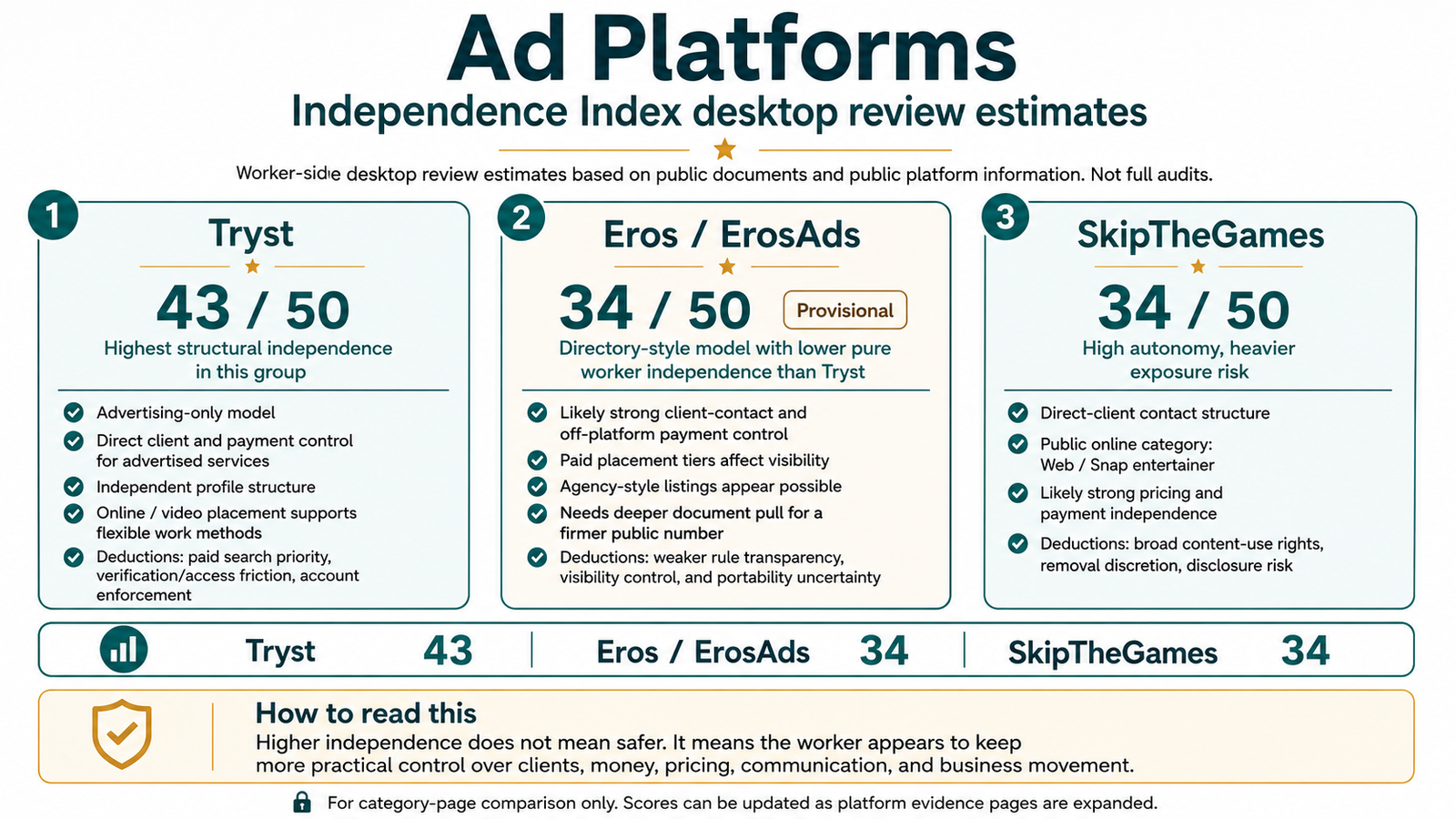
These graphics compare selected ad platforms using the 50-point Platform Independence Index. They are worker-side desktop review estimates based on public documents and public platform information. They are not full audits and may be updated as evidence pages expand.

Ad Platforms Independence Index score summary showing Tryst at 43 out of 50, Eros / ErosAds at 34 out of 50 provisional, and SkipTheGames at 34 out of 50.
Summary estimate: Tryst 43 / 50, Eros / ErosAds 34 / 50 provisional, and SkipTheGames 34 / 50.
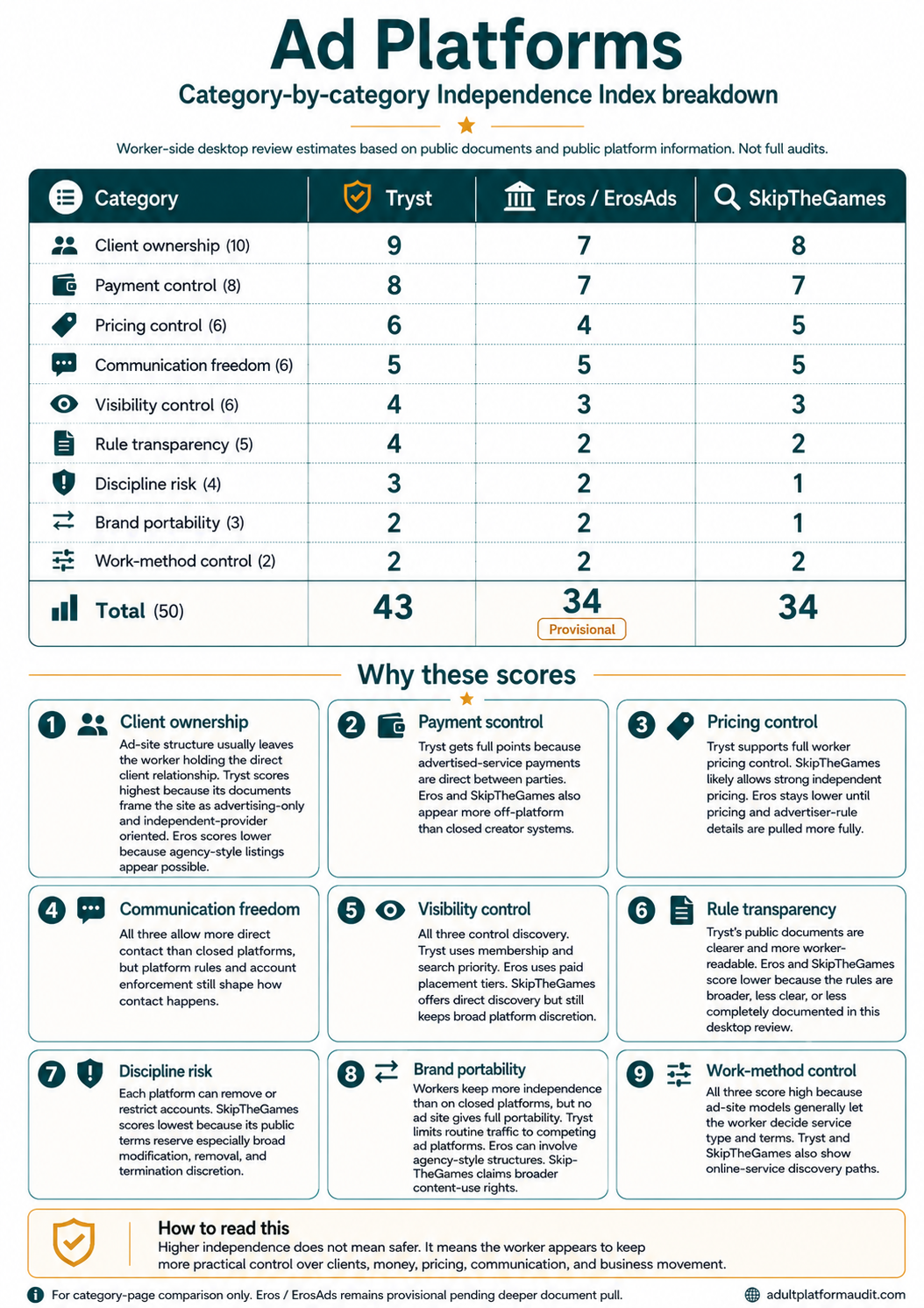
Ad Platforms Independence Index breakdown comparing Tryst, Eros / ErosAds, and SkipTheGames across client ownership, payment control, pricing, communication, visibility, rules, discipline, portability, and work-method control.
Category-by-category breakdown of the same desktop review estimates.

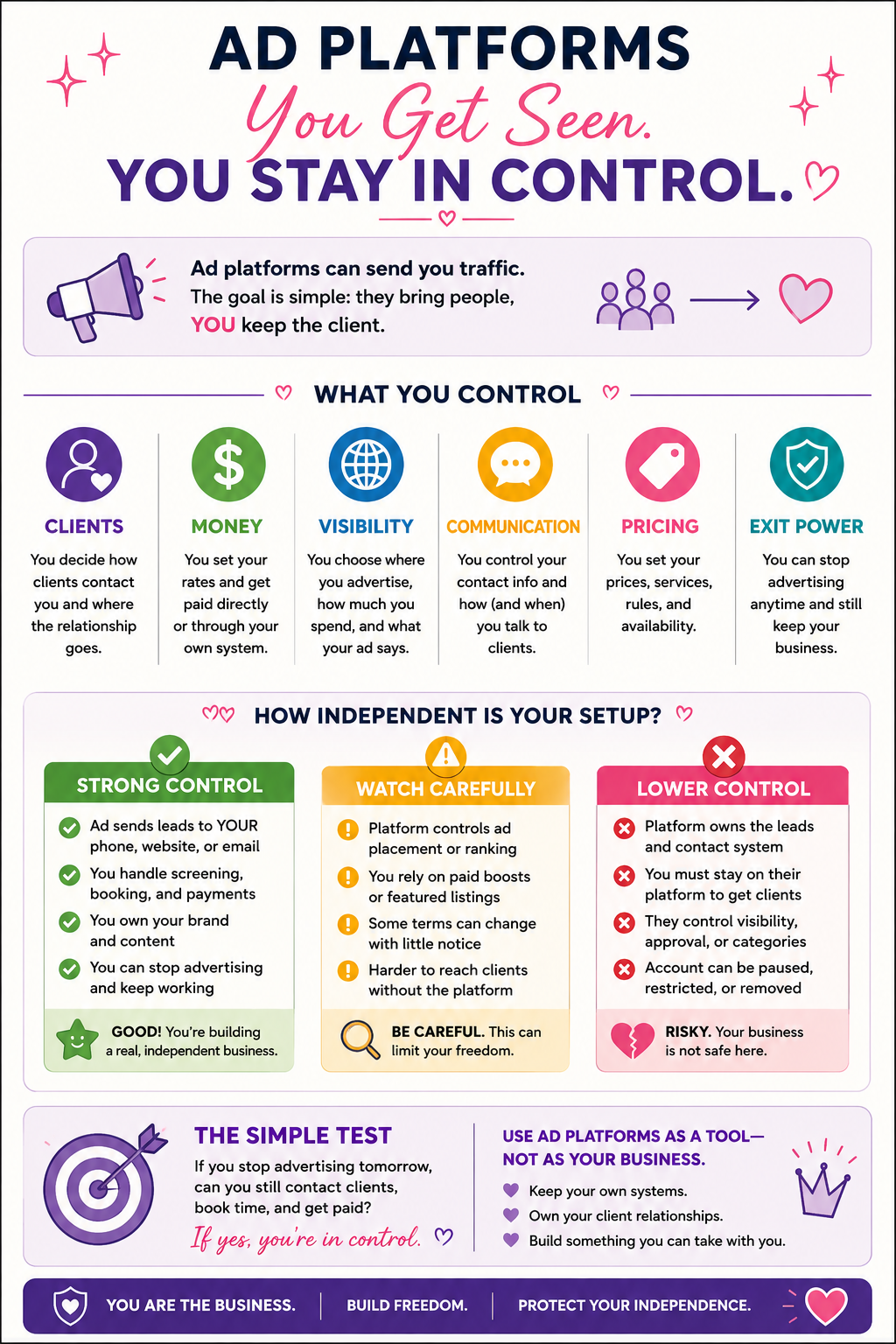
Ad Platform Control Check

A quick visual guide for models: ad platforms are strongest when they send traffic to the worker without taking over the client relationship, payment path, communication, pricing, or exit power.

Ad Platform Control Check infographic explaining how models can use ad platforms to get seen while keeping control of clients, money, visibility, communication, pricing, and exit power.

Current status: This page includes a category-level structural guide and a limited desktop comparison of selected ad platforms. The comparison is based on public-facing information available during review. It should not be treated as a safety rating, legal conclusion, endorsement, accusation, or complete audit.

What this page measures

This page applies the 50-point Platform Independence Index to directories and advertising platforms. The Index measures how much practical control a worker appears to keep over clients, payments, pricing, communication, visibility, rules, discipline, brand portability, and work method.

The score does not measure traffic volume, ad performance, income potential, popularity, legality, morality, buyer quality, or whether a platform is good or bad. An advertising platform can be useful and still structurally controlling.

Desktop review estimates

Selected ad-platform scores.

These numbers are category-page comparison estimates, not full audits. Higher independence means the worker appears to keep more practical control over clients, money, pricing, communication, and business movement.

Variable Max Tryst Eros / ErosAds SkipTheGames
Client ownership 10 9 7 8
Payment control 8 8 7 7
Pricing control 6 6 4 5
Communication freedom 6 5 5 5
Visibility control 6 4 3 3
Rule transparency 5 4 2 2
Discipline risk 4 3 2 1
Brand portability 3 2 2 1
Work-method control 2 2 2 2
Total 50 43 34 provisional 34

How to read this: Tryst scores highest in this comparison because the visible structure appears more advertising-only and independent-provider oriented. Eros / ErosAds and SkipTheGames also appear to preserve meaningful direct-client and direct-payment independence, but their lower scores reflect visibility control, rule transparency, portability, and discipline-risk concerns in this desktop review.

Scoring factors

Directory and advertising platform independence factors.

A directory can support independence when it functions as a traffic source. It becomes more controlling when it controls leads, payments, ranking, account access, or the worker’s contact funnel.

Variable Max points What to examine
Client ownership 10 Can the worker receive direct inquiries, keep client contact details, and recontact clients outside the platform, or does the platform intermediate the relationship through masked contact, internal messaging, lead controls, or account-based access?
Payment control 8 Does the worker receive direct payment from clients, or does the platform control booking payment, deposits, payment processing, fees, payout timing, refunds, holds, deductions, or access to earnings?
Pricing control 6 Can the worker set rates, minimums, packages, deposits, ad spend, discounts, and service terms, or are prices shaped by platform categories, required packages, preset fields, minimums, or paid visibility rules?
Communication freedom 6 Can the worker communicate directly with clients through phone, email, website, social links, or outside messaging, or must inquiries remain inside platform-controlled contact tools?
Visibility control 6 Does the worker control visibility through their own brand and funnel, or does the platform control placement through search, paid ads, categories, boosts, featured listings, location filters, ranking systems, or moderation approval?
Rule transparency 5 Are ad rules, image rules, listing rules, copy rules, payment rules, promotion rules, ranking rules, and enforcement standards public, clear, stable, and understandable before enforcement?
Discipline risk 4 If the platform rejects ads, removes listings, lowers visibility, blocks contact options, suspends the account, or terminates access, can the worker continue operating with minimal business interruption?
Brand portability 3 Does the worker keep control of their name, photos, website, phone number, email, social links, reputation, client funnel, ad copy, and public identity outside the directory?
Work-method control 2 Does the worker control schedule, service area, screening process, booking terms, communication style, boundaries, and working conditions, or does the platform impose meaningful operating requirements?

Common independence strengths

  • Workers may keep direct control over phone, email, website, or outside contact channels.
  • Many directories allow workers to set their own rates, availability, service area, and booking terms.
  • Listings can support a portable brand when the worker uses their own name, images, website, and client funnel.
  • Paid advertising can bring visibility without requiring the platform to process the entire client transaction.
  • Some directory models leave payment, booking, and repeat-client contact mostly outside the platform.

Common independence limits

  • The platform may control whether a listing or ad is approved, displayed, boosted, edited, removed, or renewed.
  • Visibility may depend heavily on search placement, paid upgrades, categories, location filters, or featured listings.
  • Rules for photos, wording, links, contact details, and promotion may restrict how the worker presents the brand.
  • Some platforms intermediate leads through internal messaging, masked numbers, or contact forms.
  • Account discipline can affect visibility, traffic, ad spend, client inquiries, and access to profile history.
Score bands

Ad platforms can range from high independence to high dependency.

The key distinction is whether the platform simply publishes the worker’s listing or controls the full lead, booking, payment, and communication flow.

45 to 50 Highly independent
35 to 44 Mostly independent, platform still useful
25 to 34 Mixed control and independence
15 to 24 Platform-dependent
0 to 14 Highly controlled or low independence

Key tradeoff

Directories and advertising platforms may provide reach, search visibility, listing tools, paid placement, and a way for clients to find the worker. In exchange, the worker may depend on platform rules, ad approval, ranking systems, paid visibility, and account access.

The independence question is not whether the directory sends traffic. The question is whether the worker keeps the client relationship, controls the contact funnel, receives payment independently, and can continue operating if the listing is removed or visibility changes.

Information needed for a deeper platform score

  • Current terms of service.
  • Listing, ad approval, and renewal rules.
  • Contact method rules, including phone, email, website, and social links.
  • Payment rules, if the platform handles booking, deposits, or transaction payments.
  • Search, category, boost, location, ranking, and featured placement policies.
  • Ad rejection, listing removal, appeal, suspension, and termination rules.
  • Live listing or ad testing, if available.

Bottom line.

Directories and advertising platforms can be more independent than full-service marketplaces when they let the worker keep direct contact, direct payment, pricing control, and a portable client funnel. They become more controlling when they intermediate leads, restrict contact, control booking or payment, or make visibility depend heavily on opaque ranking and paid placement systems.

A stronger independence position exists when the worker uses directories as traffic sources rather than as the business itself, keeps independent contact channels, maintains a portable brand, and can continue operating if a listing is removed or ad visibility changes.

Compare categories

Note: Adult Platform Audit is informational. It does not provide legal, financial, tax, safety, technical, privacy, data-security, or employment advice. Category guides and desktop review estimates are structural analysis, not platform endorsements, accusations, safety ratings, or legal conclusions. Platform rules, payout systems, moderation practices, ranking systems, and visibility systems can change.